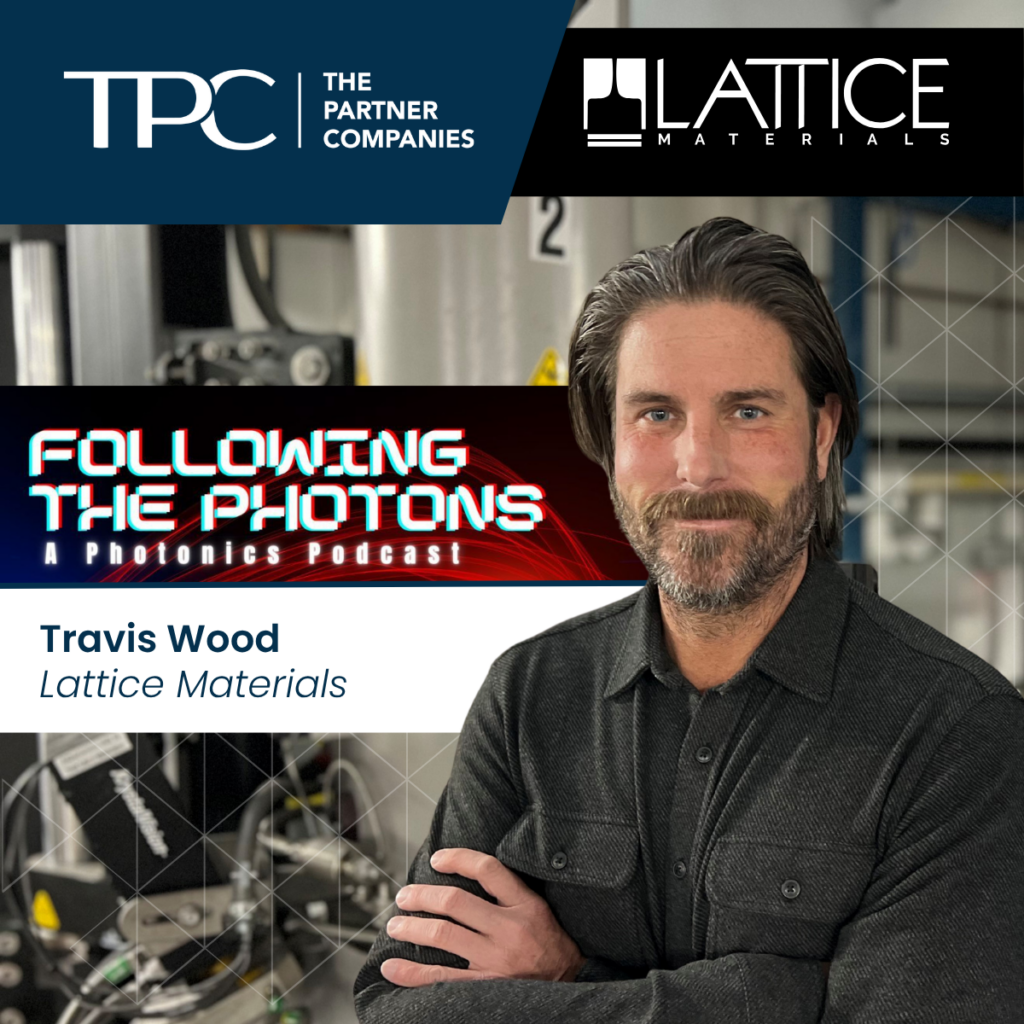
Lattice Materials President Travis Wood joined Laser Focus World’s Following the Photons podcast to discuss Lattice’s growth as a specialty manufacturer of custom infrared optics made from silicon and germanium. With host Justine Murphy, the conversation covered how Lattice’s recent $18.5 million investment from the Department of War and new facility build is evolving Montana’s photonics hub. The podcast also highlights Lattice’s strong workplace culture and its role in growing the photonics industry.
Stream the episode on Following the Photons Podcast website or any of the major podcast platforms:
Curious about the conversation? Here’s a transcript of the episode:
Host Justine Murphy (JM): Laser focused on the future of light-based technologies, this is Following the Photons: A Photonics Podcast.
I’m your host, Justine Murphy, an editor with Laser Focus World and multimedia director of Endeavor Business Media’s Digital Infrastructure group. Through interviews and discussions with researchers, company executives, students, educators, and other experts, we share diverse and unique perspectives on the issues, technologies, and trends shaping the photonics community.
Follow me on this journey into the realm of one of the most exciting industries in the world.
This episode features Travis Wood, president of Lattice Materials, a Montana based company specializing in custom infrared optics using silicon and germanium. He’s held a range of leadership positions over the past 20 years across the aerospace, defense and industrial sectors, and among other roles. He’s a board member of the Montana Photonics and Quantum Alliance. He also works closely with the Photonic and Laser Technology program at Montana State University’s Gallatin College. In our fun and interesting chat, we talked about Lattice Materials and some recent accolades, workplace culture, and the company’s ever advancing role in the photonics industry.
JM: Lattice has been awarded government funding under the Defense Production Act, 18 and a half million dollars. That’s amazing. You must be so excited. How do you feel about that? How do you guys feel?
Travis Wood (TW): Ecstatic. You know, in all honesty, it was a pretty long process. So we kind of started that application process more than a year ago. And it was through another government entity called the IBC, the Defense Industrial Base Consortium. They had disseminated an RFP and we went through that process, not knowing if we would even be considered or not. So, when we finally got the news that we were, obviously we were extremely elated and I think it was less about the dollar amount. It was more about the US government kind of investing in Lattice.
You know, of all the domestic crystal growers, which are few and far between, they kind of are making their bet on us. So for me and for a lot of the team, it was less about the monetary value of the award, but it was more on what it means about Lattice and kind of our position within a very niche industry, which you know well, Justine.
JM: Yeah. And like you said, you guys are one of what a handful of companies that do this custom grown silicon (and) germanium materials. Tell me more about those systems and things that you develop with those materials, more about the company in that way.
TW: You touched on a couple of them. But you know, some of our applications are airborne sensors, thermal targeting systems. We do weapon sites, missile guidance systems, you name it. Predominantly military applications. We use both silicon and germanium, but germanium is mostly used for military applications, and silicon is predominantly used for commercial applications. You know, going back to the DoW award, you know, we’re going to use those funds to increase our capacity. You know, that’s one of the things we’re going to be doing. And then also invest in new capabilities, one of which is internal zone refining, which we’ll be able to recycle our own scrap back into our process.
You know, when you look at our process, you’ve really got three different areas. You’ve got the crystal growth operation. We have a state-of-the-art machine shop, and then we have a high-end polish lab. The front end of the operation is really our secret sauce. It’s kind of what makes us unique. It’s a very difficult technical ability which creates high barriers to entry. There’s very few that do it, especially here in North America.
We use what’s called the Czochralski method, which is a seed crystal or a small crystal. It’s basically immersed in molten silicon or germanium in a very high temp environment. So we have these very high temp furnaces that in some cases go up fifty feet and it’s slowly pulled while rotating. And the single crystal will then grow in the direction of the pull. Where the art comes in is we have growth technicians. It’s a 24-hour operation, three to four day cycle time, but every day, within every five minutes, they’re monitoring temperature rotation, and we build the spec.
Some of the custom stuff that we do for these military applications, I mean, we’re able to do custom orientation, custom resistivity, custom optical transmission. So as they’re going through the crystal growth process and monitoring the growth for each stage, they’re also monitoring those variables that are specific to the customer spec. So there’s an art to it, if you will.
And then once we’ve created the crystal ball, which is like a, we call it a crystal ingot. So it’s just a synthetically grown crystal. We then move it into the machine shop. We have very specialized CNC machines, coring machines, Blanchard saws, etc., so we’ll cut it into puck-like shapes depending on the application.
We do a lot of windows and lenses for these military applications, so we also have the ability to curve the lenses and windows. And then when we move it into the polish lab, we have single- and double-sided polish capabilities. And that’s kind of where it ends for us in our manufacturing process.
JM: As this funding award, the announcement was released, what would you like people to know about Lattice Materials?
TW: Well, we were founded in the late ‘80s, so we originated and we’ve been here single site here in Bozeman for coming up on 40 years. So we’ve always been here. And it’s kind of unique. You know, there have been other manufacturers in this area, not just Bozeman, but also in Montana that have left the state either to go to other states in the U.S. or even out of the country for lower-cost manufacturing. But we’ve been here for almost 40 years, and we’re staying here for hopefully as many.
Our parent company is TPC. They have a portfolio of specialty manufacturing companies. I think there’s a total of 10 in the portfolio. But like I said before, we specialize in infrared optics. So windows, mirrors, we work a lot with the government programs. We’ve been doing the F-35 fighter jet for many years. We’re on existing and NextGen programs. So, you know, we do the Abrams Army tank, the legacy one, but also we’re part of Gen-III, which will be the next iteration for the Abrams X tank.
We’re one of the only U.S.-based companies that can do this custom crystal growth. And when you look at those segments of our operating process, we’re 100% U.S. manufacturing for defense and we’re vertically integrated. So that’s another thing that makes us unique within North America is we’re vertically integrated from crystal growth all the way through high-end polish. So almost kind of a one-stop shop, if you will, for our military customers.
One of the things that’s really unique to Lattice and even some of the Montana manufacturing companies is the culture. It all starts with the culture. I have not been with Lattice as long; I joined in the fall of 2023. The first thing that’s really important really with any company, you know, that has a hyper growth agenda is what’s the culture like? You know, you can’t grow a business on a faulty foundation.
One of the things that I started with when I joined was I created what we call the Employee Satisfaction Committee, and it’s very unique. I haven’t seen one of these before, but the first thing we started with was an anonymous voice of the employee survey. Just to get everything out on the table to figure out, are people enjoying what they do? Do they feel like they’re being listened to? Do they feel like their voice is heard? Do they feel like their respective, you know, and it’s a laundry list of stuff. Do they feel like they work in a safe atmosphere or environment? I wanted them to just throw everything on the table because that’s kind of the starting point.
The vision was really to be an employer of choice right here in Bozeman. So we created a charter. And part of that charter for the Employee Satisfaction Committee was building a company culture, you know, making sure that the employees have a positive work experience, making sure that there’s kind of a clear path to career development and then attractive salary benefits and community involvement.
Community involvement was really pivotal because we’ve been involved with volunteering on an ad hoc basis, but we kind of circled the troops and said, you know, what do we want to focus on? We have a lot of veterans at our facility, so we focused in on veteran volunteering. We’re intimately involved with the American Legion here in Montana with their Manhattan chapter. Bozeman has a unique nonprofit called Warriors and Quiet Waters. So we’re intimately involved with that. That’s kind of where the starting point was for us.
Obviously, there’s bold aspirations to grow a business, but once again, if you don’t have the right culture, the right foundation, you’re never going to go anywhere. And I think what we’ve done in the last two years is a testament to rebuilding the culture.
JM: That’s a fantastic idea, to just gauge what people are thinking. I’ve talked to a lot of people where they just have a hard time not only getting people on board, but keeping them so that I would assume helps. What has been the feedback?
TW: The metric kind of supports the impact. So we’ve kind of reduced our employee turnover to sub 10 percent and it was probably three to four times that before we did this. So people are staying, they’re thriving. They’re growing within the business. So far, all the feedback that we’ve gotten is very positive. We’re extremely competitive. This is a very tight labor market. As you can imagine, the city of Bozeman has 60,000 people. So we’re all competing for a finite amount of resources. So over the last two years, we’ve really amped up our competitive pay, our benefits, you know, and the most important thing is people feel like they’re being listened to and respected. They’re able to give ideas. Continuous improvement through Lean Six Sigma initiatives, coming up with innovative manufacturing ideas on how to take waste out of our processes.
Safety has been a huge, huge focus for our company. One of the things that we did with that was we implemented near-miss reporting, and the message to the employees was, near-miss reported today is an accident avoided tomorrow, and they’ve really embraced that. And it’s become part of our cultural DNA. So we’ve seen a very tight correlation between near misses reported and accidents that have been avoided. In fact, I don’t know if you had seen this past year—actually, in the fall, Lattice was awarded the Montana Governor Safety Achievement Award, and that was a testament to everything that the team has done on the safety front over the last two years. And we also do that initial voice to the employee survey. We actually do it annually. And that’s another telltale sign if we’re improving and really continuing to build on that culture. And we see the results in those surveys based on what we’ve been able to implement.
JM: You had mentioned about being around another 40 years. Are there things in the pipeline expanding?
TW: The Department of War announcement was kind of a tickler, if you will, kind of a carrot. We will be building a brand new state-of-the-art facility right here in Bozeman, and we’re going to break ground this April.
It’s going to be very exciting because we’ve kind of run out of room here. We’re currently in a 30,000+ square-foot facility. The new facility is going to be 80,000 square feet. That expansion is going to support the growing demand for infrared materials and also strengthen our domestic supply chain, specifically around germanium. So it’s going to double our current footprint.
And then we’re also going to have the necessary infrastructure, which was partly funded by the Department of War, to respond to this huge demand that we’re seeing for critical optical components in our military applications. And with that, we’re going to create jobs. We’re relatively small right now. We have about 50 employees all under one roof. This new facility, we have plans to add at least 50 new employees to the organization. It’s very exciting.
Aside from that stuff, this new facility, we touched on it earlier—you know, the new capabilities. I touched on internal zone refining. We’re going to double our crystal growth capacity. And not only just from a pure volume perspective, we’re actually going to grow bigger. Right now, kind of the norm when it comes to diameter boules—if you’re growing silicon and germanium, it’s called like the top end of that is maybe 10 to 12 inches in diameter. One of the furnaces we’re investing in is going to allow us to grow north of 20 inches in diameter. So we’re going to double the capacity. We’re going to expand the diameter with which we can crystal grow.
We’re adding internal zone refining alkali etching. We’re investing in some state-of-the-art machine shop equipment, DMG mores, all the metrology that goes along with it, everything. It’s going to be very exciting.
JM: That is exciting. Overall, just going back to this funding award and all the things you guys are doing, you know well into the future here, what does all of this mean for Lattice Materials? Because like you said, you’ve been around 40+ years at this point. Is it kind of like, I don’t want to say culminating into this amazing thing because you guys have obviously been doing well this whole time. What does this mean at this point for the company?
TW: Yeah, it means a lot. Like I said, it accelerates our ability to provide, you know, 100 percent U.S.-based manufactured germanium crystals with full traceability. It allows us to continue to grow, add headcount, you know, in the broader picture. It’s neat for the photonics industry. You’ve got those meccas—you’ve got Rochester, you’ve got kind of like the central metro area. You’ve got the East Coast when it comes to photonics and quantum. Bozeman, Montana is small, but it’s growing rapidly. And like I was saying before, you know, what’s happening in the photonics and quantum space is very exciting.
What does it mean for Lattice in the overall place in the industry? It’s continued innovation. It’s job creation. It’s growing our presence within the photonics space. And even on the innovation side, I mean, some of the stuff that we’re doing for these next-gen systems for the military, the Gen 3 flyer—it’s just really exciting.
And we do have some employees that have been here for a while. I mean, we have highly tenured employees that have been with Lattice for almost the entire time, since they’ve been here. We’ve got a few that have been here over 30 years. So over that period, to see us take that next step, you know, is super exciting for them.
JM: You work with a lot of different industries, applications, things like that. The defense part obviously is incredibly exciting and cool for you personally. What is your favorite part to be in? What do you like the best? What’s the coolest thing for you?
TW: To be honest, you know, my history is I’ve been through quite a few industries, growing and scaling businesses. And each one has been very different, I think. You know, as I look back on the last two years, it might be the sports background in me, but I enjoy building world-class teams and growing as a hockey player back in the day, super competitive. I think I’ve passed on some of that competitiveness to the rest of the team.
That’s what excites me. I mean, the technology aspect is one part, and passion for product and application. Obviously, there’s a lot of pride for what we do in protecting national security. So, I think that’s very important. But for me, it’s like I said, it’s building world-class teams and growing businesses. And I love the journey that we’re on. And I get up every day excited to work with my teammates. We have amazing team, and we’re building this dream team that’s going to be able to hit the ground running with this new facility. So that’s what I get enjoyment on. You know I mean, obviously growing the business, the financials, the getting into new programs and new applications, that’s exciting. But for me, it’s working with the team that we do every day.
And some people leave work when they go home. I take it with me and it’s not out of obligation. It’s just because I’m just so excited about what we’re doing everyday. I mean, we’re changing the photonic space here in Bozeman, and it’s not all military. We do a lot of stuff on the silicon side. We do cutting-edge medical applications. Robotic assisted surgery, we do satellite stuff. We’ve dabbled in the auto space. So, there’s a lot of stuff outside of the military applications.
JM: What are some goals that you have personally for, I guess, the business, but also for, you know, your role in it?
TW: So obviously growing the business is one of my personal goals. This next chapter, getting this new state-of-the-art facility erected on time within budget. What I would like to see from a technology perspective is us to expand our solutions offering. Right now, like I said, we’re vertically integrated from crystal growth through high-end polish, but there’s stuff on both sides of that bookend.
Where I see us in the next two to three years would be more of a total solutions provider. We think of technologies beyond high-end polish. You think about coating, you think about AR coating, you think about hard coating. You know, the next step after, we do our polish side.
So, I think about expanding our solutions offering beyond that. Within the TPC family, we have a lot of sister businesses that have a lot of synergies that could be capitalized on. You know, we have a whole photochemical etching group. We have a high-end plastics injection molding business. So, tapping into a lot of those synergies that our sister businesses have.
Again, back to the one-stop shop. How cool would it be if it’s not just Lattice supplying a germanium window, but it’s germanium window in a TPC enclosure. And that window also is coated with the anti-reflective coating because they added that capability. So for me personally, it’s expanding on that capability set and really offering a total solution to our customer, whether it’s internally through organic development or even acquisition.
I mean, M&A is always a topic in this space. It seems to have ramped up recently in the photonics space over the last few years. But that’s kind of my vision. So, you know, when I look ahead it’s total solutions provider with enhanced capabilities state-of-the-art facility up and running, twice the number of people working here and then new applications. You know, we’re finding new stuff every day.
It’s an interesting problem statement when you look at critical materials like silicon or rare earths like germanium. There’s got to be other applications. Let’s just find an industry that has a problem statement that aligns with the properties of the materials that we work with. I mean, that’s true business development. That’s how we penetrated the medical industry. We’re very U.S.-centric. There’s a lot of opportunities outside of the U.S., outside of North America, specifically in the EU region. So, I would love to see us expand outside of the North American region.
So those are some of the things that I think about. Obviously growing the business, developing the employees, making this a destination workplace, if you will. You know, because a lot of people are excited about Bozeman, Montana. I mean, you live in Vermont. I mean, there’s a nice quality of life, work-life balance. Those that live here love the outdoors. They love the mountains. They love to ski, hike, fish, hunt. To balance that with kind of a cutting-edge manufacturing company that’s doing really neat stuff when it comes to infrared optics. It’s really exciting.
The other thing, too, and it’s interesting now that I’m thinking about it—we want to be best at what we do in everything that we do. And I know that’s kind of a loaded statement. I guess the starting point was safety. So, you know, having best-in-class safety when it comes to culture and having a safe environment for everyone to work in. Obviously, that was evidenced by the Montana Governor’s Award. The next part of that journey is the environmental side. We are pretty close to getting certified for ISO fourteen thousand and one, which has to do with sustainability, energy efficiency, etc. We’re about to complete that at the end of the first quarter.
This new facility that we’re building, we’re going to pursue the LEED gold designation. So, it’s not just about the growth and the applications and the technology, it’s just being best at everything that we do and challenging the business to really stretch for those types of things.
You just mentioned an award. It was in the fall, I think it was around September. There’s an annual award by Governor Gianforte for companies and they have three buckets. They have small-, medium-, large-sized companies. We fell into the smaller category. The Governor’s Safety Achievement Award, it’s co-sponsored by the Department of Labor.
There’s a lot that goes into it. You obviously have on-site assessments and audits. They look back on your safety metrics for the last two to three years, and there’s a lot of stuff that goes into that application process. And first you have to be nominated, as well. We won that for the first time in our company’s history. They did a ceremony in Billings, Montana. Very, very exciting. And we’re going to try to carry a lot of that with us in the new facility.
We’re going to pursue the OSHA Sharp Award. I think there’s only five or six companies in the entire state of Montana that actually carry that designation. So we’re continuing to do things like that.
JM: Nice. Oh, that’s so great. And I’m sure that’s really motivating for your employees, too, you know, to work at a company that’s recognized for great things.
TW: Oh, absolutely. The rubber meets the road once again. Once it truly becomes ingrained in the cultural DNA, you know, and quality falls into that same bucket. So, in everything that they do every day. If safety and quality are top of mind, it’s part of the cultural DNA. That’s where you really see it. The awards are nice, but when you see it really ingrained in everyone’s mind and everything that they do today, that’s very important.
JM: That does it for this edition of Following the Photons. Be sure to subscribe to our podcast feed to keep up with what’s happening around the industry and to listen to new and archived episodes. And follow us on social media, too.
Until next time, keep following the photons…
Following the Photons is produced and owned by Endeavor Business Media, a division of EndeavorB2B.
*Transcript provided by Laser Focus World/Endeavor B2B